
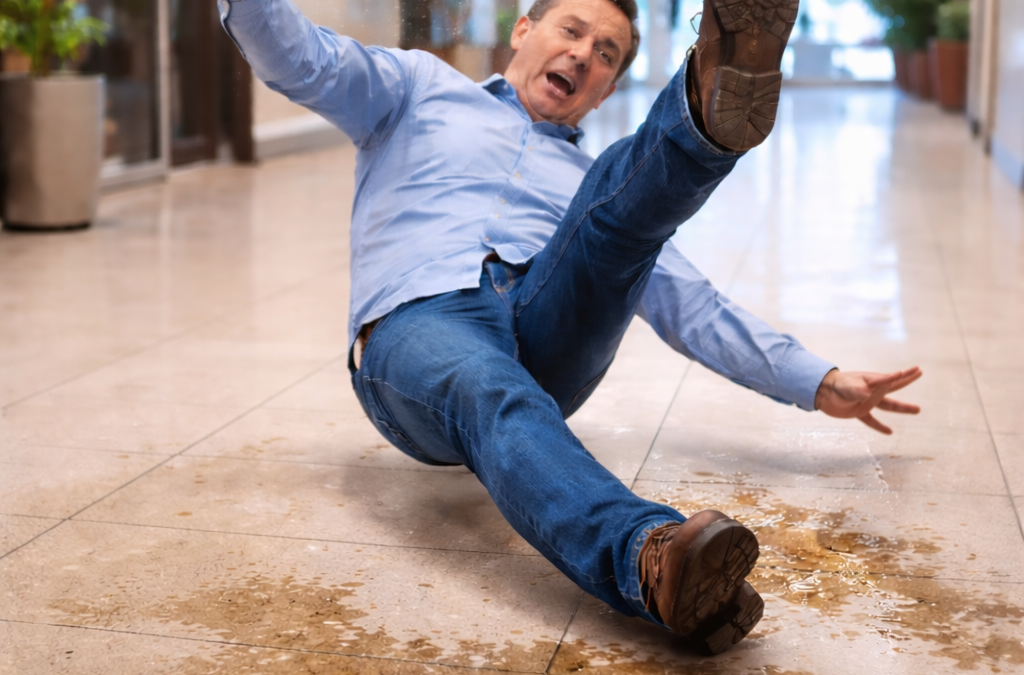
Every year, thousands of Floridians are injured in slip and fall accidents — in grocery stores, restaurants, hotels, parking lots, and private homes. These injuries can range from minor bruises to fractured hips, traumatic brain injuries, and worse. But knowing you were hurt on someone else’s property is only the beginning. To recover compensation, you must navigate one of the more challenging areas of Florida personal injury law.
This guide breaks down exactly what Florida law requires, what property owners are legally obligated to prove or disprove, and how injured victims can position themselves for the strongest possible case.
The Legal Foundation: Florida’s Premises Liability Law
Slip and fall cases in Florida fall under premises liability law, which holds property owners and occupiers responsible for maintaining reasonably safe conditions on their property. But Florida does not make this automatic — the injured person bears the burden of proving that the property owner knew (or should have known) about the dangerous condition and failed to fix it.
The key statute governing slip and fall cases in Florida is Section 768.0755, Florida Statutes, which was significantly revised in 2010 and again interpreted by courts in the years following. Under this law, if you slip and fall on a transitory foreign substance (think: a spilled drink, a wet floor, a dropped product), you must prove that the business had:
- Actual knowledge of the dangerous condition, OR
- Constructive knowledge — meaning the condition existed long enough that the owner should have discovered it through ordinary care.
This is where many slip and fall claims rise or fall.
What “Constructive Knowledge” Really Means
Constructive knowledge is the most contested element in most Florida slip and fall cases. A store owner rarely admits they knew about a puddle of water and ignored it. Instead, the battle is over whether they should have known.
Under Florida law, constructive knowledge can be proven in two ways:
1. The condition existed for a sufficient length of time
If a liquid spill sat on a grocery store floor for 45 minutes before you slipped, a court may find the store had constructive knowledge — staff patrolling the floor should have found and cleaned it. Evidence like surveillance footage, witness testimony, and the condition of the substance (dried edges, footprints tracked through it) can all help establish how long it was there.
2. The condition occurred with regularity
If the dangerous condition was foreseeable because it happens routinely in that location — for example, a produce section floor that regularly gets wet from misting systems — the property owner has constructive notice because it is a recurring hazard they should be actively managing.
What Property Owners Are Required to Do Under Florida Law
Florida law imposes different duties on property owners depending on who is visiting the property. The three categories are:
Invitees
These are people invited onto the property for a business purpose — customers at a store, guests at a hotel, patrons at a restaurant. Property owners owe invitees the highest duty of care: they must regularly inspect the premises, discover dangerous conditions, and either fix them or warn visitors.
Licensees
These are social guests — someone visiting a friend’s home, for example. The property owner must warn of known dangers that the licensee wouldn’t reasonably discover themselves, but does not have a duty to actively inspect for hazards.
Trespassers
Property owners generally owe no duty to trespassers, with one important exception: the attractive nuisance doctrine, which protects children who may be lured onto property by something dangerous (like an unfenced swimming pool).
In most commercial slip and fall cases, the injured person is an invitee — which means the highest standard of care applies, and property owners have active obligations, not just passive ones.
What Property Owners Will Try to Prove Against You
Defense attorneys and insurance companies in Florida slip and fall cases typically attack claims on several fronts. Understanding these defenses helps you anticipate and counter them.
Comparative Negligence
Florida adopted a modified comparative negligence standard in 2023 (HB 837). Under this law, if you are found to be more than 50% at fault for your own injuries, you are completely barred from recovery. If you are 30% at fault, your damages are reduced by 30%.
Common arguments property owners make include: you were distracted by your phone, you were wearing inappropriate footwear, you ignored visible warning signs, or you were running in an area marked for caution.
Open and Obvious Doctrine
Property owners often argue that the dangerous condition was “open and obvious” — that a reasonable person exercising ordinary care would have seen and avoided it. If successful, this argument can significantly reduce or eliminate liability.
Lack of Notice
As discussed above, the property owner’s most common defense is simply: “We didn’t know about it, and we couldn’t have known about it.” They will produce cleaning logs, inspection records, and employee testimony to support this.
Pre-Existing Conditions
Defense teams will dig into your medical history to argue that your injuries existed before the fall and were not caused by the incident on their property.
How to Build a Strong Slip and Fall Case in Florida
The window immediately after a slip and fall is critical. Here is what you or your attorney should do to build the strongest possible case:
1. Document Everything at the Scene
Before you leave (if physically able), photograph the exact location where you fell, the condition that caused the fall, any warning signs (or lack thereof), your injuries, and the surrounding area. These photos can be invaluable months later.
2. Report the Incident Immediately
Notify the property manager, store manager, or owner before you leave. Request that a written incident report be completed and ask for a copy. Never leave without getting documentation that the incident was formally reported.
3. Collect Witness Information
Other customers, bystanders, or even employees who witnessed the fall or knew about the hazard can be critical witnesses. Get names and phone numbers while you are still at the scene.
4. Preserve Surveillance Footage
Most commercial properties have security cameras. Surveillance footage is often automatically overwritten within 24 to 72 hours. Your attorney must send a preservation letter immediately demanding the footage be retained. This is one of the most time-sensitive steps in the entire process.
5. Seek Medical Attention Right Away
Even if you feel you can “walk it off,” see a doctor the same day or the next day at the latest. A gap in medical treatment is one of the first things an insurance company will use to argue your injuries were not serious — or were caused by something other than the fall.
6. Don’t Post on Social Media
Insurance adjusters routinely monitor plaintiffs’ social media accounts. A photo of you at a family barbecue two weeks after the fall — even if you were in significant pain — can be used to undermine your claim.
7. Hire a Florida Personal Injury Attorney
Premises liability cases are legally complex and heavily fact-dependent. An experienced attorney can subpoena records, retain expert witnesses, identify all potentially liable parties, and negotiate with insurance carriers who are trained to minimize payouts.
Florida’s Statute of Limitations: Don’t Wait
As of 2023, Florida reduced the statute of limitations for personal injury claims from four years to two years (Florida Statutes § 95.11). This means you have only two years from the date of your slip and fall to file a lawsuit. Missing this deadline almost certainly means losing your right to recover — regardless of how strong your case is.
Some exceptions exist (such as claims against government entities, which have even shorter notice requirements), so speaking with an attorney as early as possible is essential.
Final Thoughts
Slip and fall cases in Florida are winnable — but they require swift action, solid evidence, and a thorough understanding of Florida’s premises liability framework. Property owners and their insurers have experienced legal teams fighting for them from day one. Injured victims deserve the same.
If you or a loved one has been injured in a slip and fall accident in Florida, contact Slowik Law as soon as possible to protect your rights and preserve your claim.
DISCLAIMER: This blog post is for informational purposes only and does not constitute legal advice. Reading this article does not create an attorney-client relationship. Laws change frequently, and the information provided may not reflect the most current legal developments.